
logo-oibr
  • OIB
    • About
    • News
    • Director's Yearly Address
      • Director's Address 2020
      • Director's Address 2019
      • Director's Address 2018
      • Director's Address 2017
    • Advisory board
    • Reports
    • Newsletter
    • In the Media
    • Gallery
  • Events
  • Research
    • Current projects
      • Women and religion in post-conflict societies (Stephanie Dornschneider-Elkink)
      • From Arabic to Latin: Moving sciences of music around the Mediterranean (Rosy Azar Beyhom)
      • Abrahamic Interdependence - Relationship of the Islamic to the Jewish in Marital Law (Ahmed M. F. Abd-Elsalam)
      • Lebanon’s Art World at Home and Abroad: Trajectories of artists and artworks in/from Lebanon since 1943 (LAWHA) (Nadia von Maltzahn)
      • Cultural Policies in Lebanon: Cultural Institutions between State and Society (Nadia von Maltzahn)
      • The New Testament quotations in Ibrahim al-Biqāʿīs (st. 1480) commentary on the Koran (Thomas Würtz)
      • Balance as Justice: Deconstruction of premodern ethics on the basis of Qinālīzāde ꜤḲınālīzāde ʿAlī Çelebī’s Akhlāq-i ꜤAlā’ī (Fatih Ermiş)
      • Fictio Statis (Pierre France)
      • Discourses on Statehood in Iraq (Christian Thuselt)
      • From Copying to Burning the Qur’an: Creating Models & Transposing Sacrality (Alya Karame)
      • Living in Liminality (Sarah El Bulbeisi)
      • Escape to Europe: Comparative Refugee Imaginaries (Markus Schmitz)
    • Previous projects
      • The Lebanese Intifada of October 17: Perspectives from Within (Birgit Schäbler)
      • Relations in the Ideoscape: Middle Eastern Students in the Eastern Bloc (1950's to 1991) (Birgit Schäbler)
      • Europe and the Middle East (Birgit Schäbler)
      • Picturing the (Un)Dead: Reflections and Deconstructions of Lebanese and Iranian "Martyrs" in Contemporary Photo-Related Art-Practices (Agnes Remeder)
      • Hierarchical Rationality of Religious Beliefs System in Islamic and Christian Theology (Qodratullah Qorbani)
      • The inimitability of the Qur’ān (i‘jāz al-qur’ān) in transconfessional contexts of the early ῾Abbāsid period (Hans-Peter Pökel)
      • Cultural Mobilities and Political Spaces (Christopher Bahl)
      • Al-Qadi al-Fadil (Stefan Leder)
      • Bedouin Syria (Johann Büssow)
      • Borrowing and lending (Jonathan Kriener, Ruhr-Universität Bochum)
      • Clergy and conflict management (Thomas Scheffler)
      • Higher Education and Citizenship in Egypt (Daniele Cantini)
      • History Writing at Lebanese Universities (Jonathan Kriener)
      • Knowledge in postgraduate studies (Daniele Cantini)
      • Mamâlik – Spatial Dynamics of Islamic Polities (Kurt Franz)
      • Media culture transformation (Hanan Badr)
      • Museums in Dialogue with the Future (Felicia Meynersen)
      • Political slogans (Nader Srage)
      • Political thought (Stefan Leder)
      • Rural societies in an age of urbanisation (Astrid Meier)
      • S.C.R.I.P.T. - Source Companion for the Research on Islamic Political Thought (Stefan Leder)
      • Talking about art – aesthetic reflection in Egypt and Lebanon (Monique Bellan)
      • Tracing an author’s library (Torsten Wollina)
      • A Literal World: Perceiving the World as a Linguistic Construction before the Emergence of the Metaphor in Arabo-Islamic Thought (Abdallah Soufan)
      • Open Arabic Periodical Editions (OpenArabicPE) (Till Grallert)
      • “Women on the streets!: a genealogy of food riots in the Middle East between the 18th and 20th centuries“ (Till Grallert)
  • People
    • Directorate
    • Research Associates
    • Visiting Fellows
    • LAWHA Team
    • Affiliated Researchers
    • Alumni
    • Library
    • Administration
    • IT
    • Publications
    • Technical Staff
    • Vacancies
      • Kinderbetreuung / Leben und Arbeiten im Libanon
  • Publications
    • BI · Bibliotheca Islamica
      • About BI
      • Recent Issues
      • Full List
    • BTS · Beiruter Texte und Studien
      • About BTS
      • Recent Issues
      • Full List
    • OIS · Orient Institut Studies
      • About OIS
      • Recent Issues
      • Full List
    • Extra Series
      • About
      • Recent Issues
      • Full List
    • Latest Publications
  • Library
    • About
      • Library Team
      • History
    • OIB Catalogues
      • GoTriple
      • OPAC
      • IPAC
    • Repositories & databases
    • Online registration
    • Collection
    • Library Regulations
  • Academic Support
    • Fellowships
      • Doctoral Fellowships
      • Postdoctoral Fellowships
      • OIB Research Relief Fellowships 2022/2023
      • Hans-Robert Roemer Fellowships
    • Affiliations
    • Internships
    • Guest rooms
Back to Events

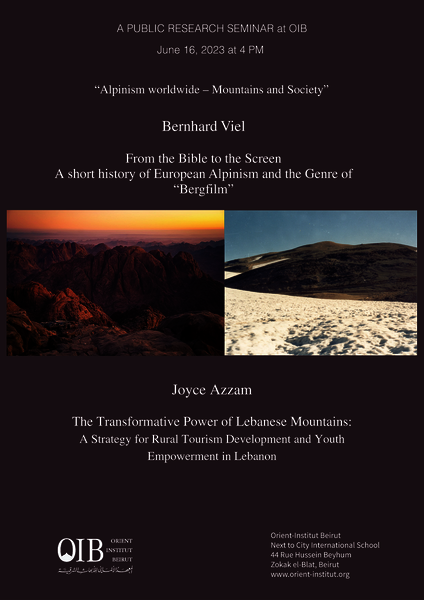
The second day of the seminary “Alpinism worldwide – Mountains and Society”

Public research seminar

Orient-Institut Beirut

Friday, 16. June 2023, 16:00-18:00
16
June

Click on the event's poster to maximize


Live streaming link: https://maxweberstiftung-oi-beirut.webex.com/maxweberstiftung-oi-beirut/j.php?MTID=md6fd8600be2f0b53e106be6adc4d51de

“Alpinism worldwide – Mountains and Society


Abstract:

The second day of the seminary “Alpinism worldwide – Mountains and Society” we will start with a talk by Bernhard Viel “From the Bible to the Screen. A short history of European Alpinism and the Genre of “Bergfilm””. At the evening Joyce Azzam will speak about the Lebanese perspective of Alpinism “The Transformative Power of Lebanese Mountains: A Strategy for Rural Tourism Development and Youth Empowerment in Lebanon”.


“From the Bible to the Screen. A short history of European Alpinism and the Genre of “Bergfilm””

In the beginning, the Bible tells us that on the third day, according to the Book of Genesis, the Lord created the land and the sea. This marked the genesis of European alpinism, as demonstrated by Bernhard Viel in his panoramic view of alpine history. During this time, there was an effort to reconcile the natural history explanation for the formation of the Alps, which had been established since the 18th century, with the creation report. In the 19th century, scientific interest prevailed, and the gods were banished. Climbing mountains, once feared, became fashionable to gain insights into the Earth's history and to be enchanted by the newfound beauty of the mountain landscapes. However, this fascination soon gave rise to a heroic and national ethos, with men and women driven by the ambition to demonstrate courage, manliness, and the ability to rise to challenges.

After World War I, the mountains were conquered by the film industry, transforming them into playgrounds for restless urban recreational enthusiasts. The demystification of the alpine landscapes coincided with their romantic portrayal in the new mass medium. Bernhard Viel illustrates this transformation through the example of Luis Trenker, a South Tyrolean mountaineer born in 1892, who contributed to the international acclaim of the revolutionary ‘mountain film’ genre with movies like ‘Berge in Flammen’ (1932) [English title: ‘The Doomed Battalion’]. This genre has since influenced the aesthetics of war, adventure, and sports films.


‘The Transformative Power of Lebanese Mountains: A Strategy for Rural Tourism Development and Youth Empowerment in Lebanon’

This study proposes the utilization of mountaineering and hiking activities in Lebanon as a catalyst for promoting rural and environmental tourism while also fostering a sense of citizenship among the youth. By leveraging the popularity of mountaineering and nature-based recreation, this approach seeks to revive tourism in rural areas while concurrently nurturing a stronger connection between the younger generation and their communities. Through the physical and mental challenges that mountaineering presents, participants are able to transcend their limitations and tap into their inner strength, building confidence and resilience that can be applied to all areas of their lives. This transformative power of mountaineering can inspire individuals to embrace new perspectives, cultivate a greater appreciation for nature, and develop a sense of interconnectedness with the world around them. Ultimately, it is hoped that this approach will not only promote tourism and civic engagement but also contribute to the holistic development of the individuals involved.


Bios:

Bernhard Viel, born in Munich in 1958, is a PhD in German studies and history. His books and essays are dedicated to prominent figures in the intellectual life of the 19th and 20th centuries. He resides as a freelance author in Berlin and Munich.
Joyce Azzam was born on June 24, 1984. She holds the record of being the only Lebanese woman to complete the Seven Summits Challenge. Azzam earned a PhD in landscape & environment management from La Sapienza University of Rome. She has been designated as Goodwill Ambassador for Himalayan Life International.


Find us on Google Maps


    • footer logo
    • footer log2
    • DATA PROTECTION DISCLAIMER
    • SITEMAP
    • IMPRESSUM
    • Rue Hussein Beyhoum 44
      Zokak el-Blat
    • +9611359423
    • sek@orient-institut.org

Follow us:

© 2023, OIB All Right Reserved / OIB Alle Rechte vorbehalten.