
Professor of Political and Social Aesthetics
Email: skhatib@hfg-karlsruhe.de
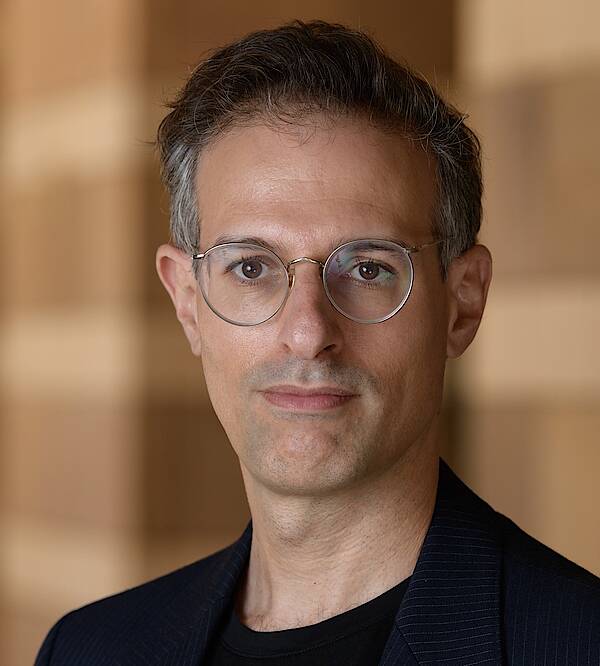
Sami Khatib holds an MA degree in Media Studies and Philosophy (2004) and a PhD degree in Media Studies (2013) from Freie Universität Berlin; he is professor of Political and Social Aesthetics at Karlsruhe University of Arts and Design (HfG). He specializes on Critical Theory with interdisciplinary research interests in Philosophy, Aesthetic Theory, Visual Arts, Media Theory, and Cultural Studies. He joined OIB from October 2023 to November 2024 as a research associate. In 2025, he co-organizes the lecture series “Kant and the Non-European: Critique, Justice and Freedom” and the international conference “Catastrophe, Memory & Critique,” scheduled at OIB for 3-5 June 2025.
Prior appointments include guest professorships at the Karlsruhe University of Arts and Design (2021-23) and the Institute of Philosophy and Sciences of Art at Leuphana Universität Lüneburg (2020-21), a professorship of Visual Arts at the American University in Cairo (2019-20), a postdoctoral fellowship at the DFG research training group “Cultures of Critique” at Leuphana University Lüneburg (2017-18), a visiting professorship of philosophy and aesthetics at the Academy of Fine Arts Vienna (2017), a visiting professorship at the Department of Fine Arts and Art History at the American University of Beirut (2016-17), and a Mellon postdoctoral fellowship at the Center for Arts and Humanities at the American University of Beirut (2015-16).
International Conference, 3-5 June 2025, organised by Sami Khatib & Jens-Peter Hanßen
This international conference was originally planned for 20-22 May 2024 under the title “Crisis, Memory & Critique” to mark the 25th anniversary of the foundational “Crisis & Memory” Summer Academy at the OIB. We decided to postpone and reconceptualize the conference’s framing. The conference now takes place at the OIB from the evening of 3. to the evening of 5. June 2025.
We have replaced the concept “crisis” with “catastrophe” in the event’s title to encourage our participants to consider what happens to our analysis if we adjust the scales of history and the stakes of our inquiry to the unchartered nature of our present. “Catastrophe, Memory & Critique” still aims to take stock of how the field of memory studies has metamorphosed and expanded internationally since the landmark OIB summer academy in 1998.
But we sense that the experiences and horizons of the 1990s were so utterly different and, indeed, much more stable than the experiences and horizons we inhabit in early 2025, that we call for new analytical registers, genealogical approaches and comparative angles to comprehend the present moment of history.
In times of genocide, war, economic collapse and fascist resurgences, our conference aims to interrogate the relationship between memory and critique in relation to three contested fields of research: (1) migration and memory politics in Europe and the MENA region (2) archives of catastrophe and critique in the Arab intellectual tradition; (3) overcoming genocide, war, and dictatorship.
The conference is generously sponsored by the German Research Council (DFG) and gathers scholars of Palestine, Lebanon, Syria, Iraq, Algeria, France, Germany and the Holocaust to explore collectively particularities and connections, new insights from the past and the very validity of past paradigms.
Authors: Sami Khatib & Jens-Peter Hanßen
Lecture series from September 2024 until April 2025 in collaboration with the American University of Beirut (AUB)
On the occasion of the 300th anniversary of the birth of the Königsberg philosopher Immanuel Kant (1724-1804), the Orient-Institut Beirut (organizers Sami Khatib and Jens Hanssen) and the Center for Critical Humanities for the Liberal Arts (CHLA) of the American University of Beirut are organizing a series of lectures and panel discussions on key Kantian concepts, their legacies and circulations. The purpose of the event series is two-fold: (1) investigating the legacy and contemporary relevance of Kantian key-concepts such as critique, enlightenment, justice, reason and freedom today in Europe, the MENA region and beyond; (2) exploring the question of circulation, translation and reconceptualization of Kantian and cognate philosophical concepts within the MENA region.
The organizers are interested in more recent accounts of Kant’s limited, i.e. Eurocentric, notion of universality and how historical and epistemic limitations of his age are ingrained in his notions of anthropology, history and teleological progress. At the same time, the organizers and guests discuss the radical potentials of some of his key concepts (e.g. sensus communis, public use of reason, aim of nature, radical evil), which resist their full historicization within the context of Enlightenment thought and early German Idealism.
Overall, this series of lectures and panels also attempts to bring the Kantian legacy of continental philosophy in conversation with modern Arabic intellectual history. Of particular interest is the Nahda, the period and project of cultural effervescence from the beginning of the nineteenth to the middle of the twentieth century. Depending on one’s interpretation, it represents the beginning of a still "unfinished" Arab drive for enlightenment and emancipation, or it marks the colonial end of an independent cultural development. Either way, the Nahda represents a kind of Archimedean point for Arab modernity on which truth claims about the Arab past and future have been balanced ever since.
Authors: Sami Khatib & Jens-Peter Hanßen
Current Publication Projects
Book: Realabstraktion: Die Geburt der Ästhetik aus dem Geiste des Kapitalismus [working title, “Real Abstraction: The Birth of Aesthetics from the Spirit of Capitalism”], projected for 2025.
Jan Sieber: Das ästhetisch Unbewusste [The Aesthetic Unconscious], ed. Sami Khatib, Jenny Nachtigall, Samo Tomšič, Vienna: Turia + Kant, Feb 2025.
Irving Wohlfarth: Collected Essays on Walter Benjamin [working title], ed. Sami Khatib, Jan Sieber (†), vol. 1: “Always radical, never consistent,” London: Verso, forthcoming 2025.
Book
“Teleologie ohne Endzweck.” Walter Benjamins Ent-stellung des Messianischen [“Teleology without End”: Walter Benjamin’s Dislocation of the Messianic], Marburg: Tectum, 2013, URL .
Co-Edited Volumes
Critique: The Stakes of Form , ed. Sami R. Khatib, Holger Kuhn, Oona Lochner, Isabel Mehl, Beate Söntgen, Zürich, Berlin: Diaphanes, 2020.
Journal Articles and Book Chapters (peer reviewed)
"Beyond Mysticism and the Apocalypse: Benjamin's Dislocation of the Messianic," in Benjamin and Political Theology, ed. Brendan Moran and Paula Schwebel, London: Bloomsbury, 2024, 195-211.
“Marx, Real Abstraction and the Question of Form,” in: Critique: The Stakes of Form, ed. Sami R. Khatib, Holger Kuhn, Oona Lochner, Isabel Mehl, Beate Söntgen, Zürich, Berlin: Diaphanes, 2020, 69-92.
“Karl Marx. Mit Benjamin für Marx, mit Marx für Benjamin,” in Entwendungen – Walter Benjamin und seine Quellen, ed. Jessica Nitsche, Nadine Werner, München: Fink, 2019, 321-347, URL .
“Chapter 37: Society and Violence,” in Sage Handbook of Frankfurt School Critical Theory, Vol. 2, ed. Werner Bonefeld, Beverley Best, Chris O’Kane, Newbury Park: Sage, 2018, 607-624, URL .
“Barbaric Salvage: Benjamin and the Dialectics of Destruction,” special issue on “Barbarisms,” parallax, 2018, Vol. 24, No. 2, 135-158, URL .
“Practice Makes Perfect. On Undoing Bourgeois Pedagogy,” special issue on “Walter Benjamin, Pedagogy and the Politics of Youth,” eds. Matthew Charles and Howard Eiland, boundary 2, Vol. 45, No. 2, 2018, 63-86, URL
“Where the Past Was, There History Shall Be: Benjamin, Marx, and the ‘Tradition of the Oppressed’,” special issue on Walter Benjamin: “Discontinuous Infinities,” eds. Jan Sieber and Sebastian Truskolaski, Anthropology & Materialism. A Journal of Social Research, 1/2017, URL .
“‘Sensuous Supra-Sensuous’: The Aesthetics of Real Abstraction,” in Aesthetic Marx, ed. Samir Gandesha and Johan F. Hartle, London: Bloomsbury, 2017, 49-72, URL .
“No Future: The Space of Capital and the Time of Dying”, in Former West: Art and the Contemporary after 1989, ed. Maria Hlavajova and Simon Sheikh, Cambridge, MA: MIT Press, 2017, 639-652, URL .
“Towards a Politics of ‘Pure Means’: Walter Benjamin and the Question of Violence,” in Conflicto armado, justicia y memoria, Tomo 1: “Teoría crítica de la violencia y prácticas de memoria y resistencia,” ed. Enan Enrique Arrieta Burgos, Medellín: Editorial de la Universidad Pontificia Bolivariana, 2016, 41-65, URL
“Melancholia and Destruction: Brushing Walter Benjamin’s ‘Angel of History’ Against the Grain”, special issue “Politics and Melancholia”, eds. Dominiek Hoens and Justin Clemens, Crisis and Critique, vol. 3, issue 2, September 2016, 20-39, URL .
“Walter Benjamin and the Subject of Historical Cognition,” special issue “Walter Benjamin Unbound,” eds. Alexander Gelley, Ilka Kressner and Michael G. Levine, Annals of Scholarship, Vol. 21.1, 2015, 23-42, URL .
“‘To Win the Energies of Intoxication for the Revolution’: Body Politics, Community, and Profane Illumination,” Anthropology & Materialism. A Journal of Social Research, 2/2014: “The Persistence of Myth,” URL .
“A Non-Nullified Nothingness: Walter Benjamin and the Messianic,” Stasis. Journal in Social and Political Theory, First Issue: “Politics of Negativity,” Fall 2013, 82-108, URL .
“The Messianic Without Messianism. Walter Benjamin's Materialist Theology,” Anthropology & Materialism. A Journal of Social Research, 1/2013: “Across the Fields,” UR L
“The Time of Capital and the Messianicity of Time: Marx with Benjamin,” Studies in Social and Political Thought, Vol. 20, Winter 2012/13, Sussex, 46-69, URL .
“Walter Benjamins ‘trans-materialistischer’ Materialismus. Ein Postskriptum zur Adorno-Benjamin-Debatte der 1930er Jahre,” in Am Kreuzweg von Magie und Positivismus. Walter Benjamin und die Anthropologie, ed. Carolin Duttlinger et al., Freiburg: Rombach, 2012, 149-178.
Journal Articles and Book Chapters
“Benjamin’s materialism: anthropological, historical or dialectical?,” in The Palgrave Walter Benjamin Handbook, ed. Nathan Ross, London: Palgrave, 2025 (forthcoming).
“Ideologie,” in Žižek-Handbuch, ed. Dominik Finkelde, Stuttgart: Metzler, 2025 (forthcoming).
“Marx,” in Žižek-Handbuch, ed. Dominik Finkelde, Stuttgart: Metzler, 2025 (forthcoming).
“History Disintegrates into Images,” Symploke, special section on Fredric Jameson’s “The Benjamin Files,” ed. Robert Tally, Spring 2024.
“Language in the Age of Its Capitalist Translatability,” in Walter Benjamin and Antonio Gramsci: A Missed Encounter, ed. Dario Gentili, Elettra Stimilli, Gabriele Guerra, London: Routledge, 2024.
“A Positive Concept of Barbarism: Benjamin and the Consequences,” e-flux journal, issue 141, December 2023, URL .
“La lingua nell'epoca della sua traducibilità capitalista,” trans. Gabriele Guerra, in Un incontro mancato: Walter Benjamin e Antonio Gramsci, Dario Gentili, Elettra Stimilli, Gabriele Guerra (eds.), Rome: Quodlibet, 2023, 219-234.
“Aesthetics of the ‘Sensuous Supra-Sensuous’,” Selva, Fall 2022, issue 4, 89-102, URL .
“Singularitätseffekte,“ Historiker Streiten, ed. Susan Neiman and Michael Wildt, Berlin: Ullstein, Propyläen, 2022, 59-74.
“Palestine and its German Discontents,” Journal of Visual Culture, Volume 20, Issue 2: The JVC Palestine Portfolio, Sept. 2021, 238-241.
“Art and Scholarship in Moments of Historical Danger,” Roundtable contribution in Vardan Azatyan, Frederic J. Schwartz, T. J. Clark, Sami Khatib, Miško Šuvaković, Ursula Frohne; Art and Scholarship in Moments of Historical Danger, ARTMargins 2021; 10 (3), 177-181, URL .
“The Drive of Capital: Of Monsters, Vampires and Zombies,” Coils of the Serpent: Journal for the Study of Contemporary Power, Special issue “Im/Possibility: On the Production, Distribution, and Articulation of the Possible and the Impossible,” ed. Dennis Büscher-Ulbrich et al., Feb. 2021, 101-113, URL .
“The Perpetual Recurrence of Primitive Accumulation: Reading Karl Marx with Rosa Luxemburg,” in Beyond Repair, ed. Natascha Sadr Haghighian, Ernest Ah, Berlin: Archive Books, 2020, 80-92.
“How to Exhibit the Spatialization of History?,” in Theater, Garden, Bestiary: A Materialist History of Exhibition, ed. Tristan Garcia, Vincent Normand, Berlin: Sternberg Press, 2019, 259-268.
“‘Sinnlich übersinnlich’”: Die Ästhetik der Realabstraktion,” in Marx und die Krise, ed. Mauro Ponzi, Altea Koenig, Würzburg: Königshausen u. Neumann, 2019, 73-95, URL .
“What Does Art Exhibit? Remarks on ‘Exhibition Value’,” “Exhibiting Matters,” eds. Milica Tomić and Dubravka Sekulić, GAM, 2018, Vol. 14, 54-59, URL .
“Realism Today?” roundtable discussion, ed. Octavian Eşanu, ARTMargins, 2018, Vol. 7, No. 1, 58-82.
“Walter Benjamin’s Figures of De-Figuration: The Barbarian, the Destructive Character, and the Monster,” in Benjamin’s Figures - Dialogues on the Vocation of the Humanities, ed. Madeleine Kasten, Rico Sneller, Gerard Visser, Nordhausen: Bautz, 2018, 71-92.
La desfiguración mesiánica. Walter Benjamin y Franz Kafka,” Spanish trans. Nicolás García, in Franz Kafka: culpa, ley y soberanía, ed. Esteban González Jiménez, Medellín: Editorial de la Universidad Pontificia Bolivariana, 2017, 197-219.
“Response to ‘Art, Society/Text: A Few Remarks on the Current Relations of the Class Struggle in the Fields of Literary Production and Literary Ideologies’, ed. Karen Benezra, ARTMargins, 2017, Vol. 6, No. 3, 50-81.
“Medio messianico. La politica della lingua in Benjamin,” Italian trans. Stefano Marchesoni, in Walter Benjamin, Gershom Scholem e il linguaggio, ed. Tamara Tagliacozzo, Milano, Udine: Mimesis Edizioni, 2016, 17-38.
“Die Armut des Denkens. Anmerkungen zu Benjamin und Brecht,” in “Um Abschied geht es ja nun...” Festschrift für Hermann Haarmann, Marburg: Tectum, 2015, 41-64.
“Politics of ‘Pure Means’: Walter Benjamin on Divine Violence,” Black Box: A Record of the Catastrophe, PM Press, Vol. 1, Dec. 2015, 87-103.
“Messianisches Medium. Benjamins Sprachpolitik,” Rivista Italiana di Filosofia del Linguaggio, ed. Tamara Tagliacozzo, Vol. 8, N. 2: “Walter Benjamin, Gershom Scholem and Language,” Dec. 2014, 155-170, URL .
“Walter Benjamin und Karl Marx. Der ‘Begriff der Geschichte’ und die ‘Zeit des Kapitals’,” in Der sich selbst entfremdete und wiedergefundene Marx, ed. Helmut Lethen et al., München: Fink, 2010, 227-244.
“Geschichte, Retroaktivität, Text – Erkundungen zum ‘Begriff der Geschichte’ mit Walter Benjamin und Slavoj Zizek,” in Retrospektivität und Retroaktivität. Erzählen - Geschichte - Wahrheit, ed. Marcus A. Born, Würzburg: Königshausen u. Neumann, 2009, 235-249.
Reviews (Selection)
“Alexander Gelley. Benjamin’s Passages –Dreaming, Awakening”, in The Germanic Review: Literature, Culture, Theory, New York: Fordham UP, Spring 2016, vol. 91:2, 199-206.
“Jennings, Michael W.; Eiland, Howard: Walter Benjamin. A Critical Life”, in The New Inquiry (April 2014), URL .
“Heinz Brüggemann, Günter Oesterle (eds.): Walter Benjamin und die romantische Moderne” published on the website of the International Walter Benjamin Society, Jan. 2010, URL .
“Falko Schmieder: Ludwig Feuerbach und der Eingang der klassischen Fotografie. Zum Verhältnis von anthropologischem und Historischem Materialismus,” in Weimarer Beiträge, 4/2007, 627-631.
Essays in Catalogues
“The Split between the Eye and Gaze: Visual Arts as Medium of Theory,” The Large Glass – Journal for Contemporary Art, Culture and Theory, ed. Tihomir Topuzovski, Matthew Fuller, Museum of Contemporary Art – Skopje, special issue, winter 2024/25.
“Aura, or On Photographic Drive,” in Jaka Babnik, Pygmalions, Jakopic Gallery, City Museum, Ljubljana, 2019.
“Dialektik der Faltung,” in Anne Gathmann, Statik der Resonanz, Elisabethkirche Kassel, exhibition on the occasion of documenta 14, Kassel, 2017.
“Undead Labour: Un/Spinning the Time of Real Abstraction,” in The Economy is Spinning, ed. Kris Dittel, OMP 132, Eindhoven, Feb. 2017, 48-59.
“This is the Reproducibility of Singular Time,” in This is the Time. This is The Record of the Time, eds. Angela Harutyunyan and Nat Muller, Beirut: AUB Press 2016, 40-49.
“Fugues of Time,” in Rapture, part 2/3, ed. Office for Contemporary Art Norway (OCA), publication produced on the occasion of Camille Norment’s participation at La Biennale di Venezia for Art in 2015, Oslo, 2016, 53-83.